
by Prateek Chopra | July 3, 2026 | Diabetes Conferences | ADA 2026
Cardiovascular Risk Assessment
- This analysis evaluated the relationship between inflammation (hsCRP), obesity (BMI), and cardiovascular outcomes in individuals with chronic kidney disease (CKD) and type 2 diabetes (T2D).
- The impact of finerenone across different hsCRP and BMI categories was also assessed.
Methods
- Participant-level pooled analysis from the FIDELITY program involving adults with CKD and T2D.
- Associations between baseline hsCRP, BMI, and cardiovascular outcomes were evaluated using adjusted statistical models.
Study Population
- 12,864 participants.
- Mean age: 65 ± 10 years.
- Female: 30%.
- Median hsCRP: 2.2 mg/L.
- Elevated hsCRP (≥2 mg/L) was present in 53% of participants.
Key Findings
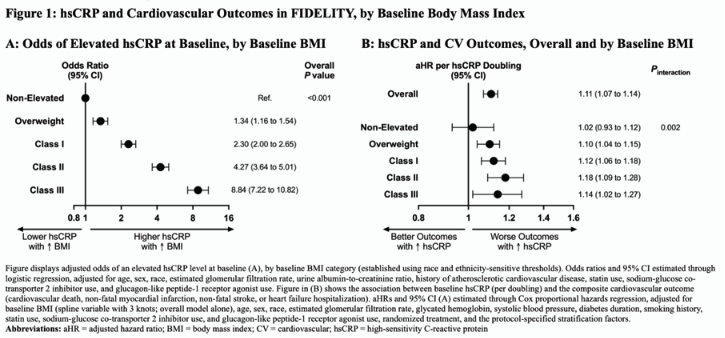
- Higher BMI was strongly associated with increased odds of elevated hsCRP.
- Elevated hsCRP was associated with a higher risk of composite cardiovascular events:
- HR per hsCRP doubling: 1.11 (95% CI: 1.07–1.14).
- The association between inflammation and cardiovascular risk was primarily observed in individuals with elevated BMI (P-interaction=0.002).
Effect of Finerenone
- Finerenone reduced cardiovascular risk consistently across hsCRP and BMI subgroups.
- Treatment benefits were not influenced by baseline inflammatory burden (P-interaction=0.21) or BMI (P-interaction=0.43).
Clinical Implications
- Low-grade inflammation is common in patients with CKD and T2D and may contribute to residual cardiovascular risk, particularly among those with obesity.
- Finerenone provides consistent cardiovascular protection regardless of inflammatory status or adiposity.
Low-grade inflammation and obesity jointly contribute to cardiovascular risk in CKD and T2D. Finerenone maintained consistent cardioprotective benefits across all hsCRP and BMI categories, supporting its use for cardiovascular risk reduction in this high-risk population.