
by Prateek Chopra | May 30, 2026 | Cardiology Conferences | ESC-HF 2026
Heart failure (HF) remains associated with substantial mortality and morbidity despite advances in therapy. Guideline-directed medical therapy improves outcomes in heart failure with reduced ejection fraction (HFrEF); however, adherence in routine clinical practice remains variable. This study evaluated adherence to guideline-recommended diagnostic and therapeutic strategies among patients newly diagnosed with HF in a General Hospital in the United Kingdom. Demographic characteristics, etiologies, duration of hospital stay, and reasons for non-prescription of therapies were also assessed. The findings were presented at Heart Failure 2026, organized by the European Society of Cardiology, held in Barcelona, Spain, from 9–12 May 2026.
A retrospective review was conducted using records of patients discharged with newly diagnosed HFrEF between October 2023 and June 2024. Patients with previously established HFrEF were excluded. Fifty eligible patients were included, and data regarding investigations, pharmacological therapy, contraindications, and follow-up arrangements were analyzed.
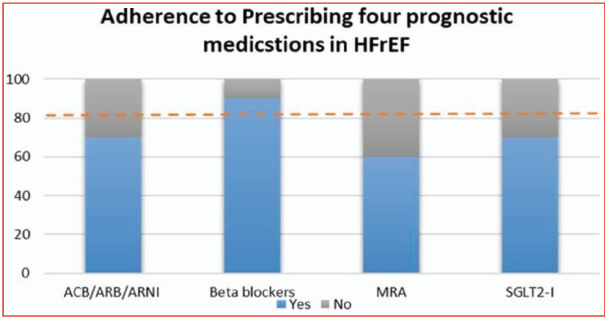
Most patients were male and aged 75–84 years. NT-proBNP testing was performed in 86% of patients, while all underwent inpatient echocardiography. Arrhythmias and ischemic heart disease were the leading causes of HF. Prescription rates for beta blockers, ACE inhibitors/ARBs, SGLT2 inhibitors, and mineralocorticoid receptor antagonists (MRAs) were 90%, 70%, 70%, and 60%, respectively. Asthma/COPD was the main reason for withholding beta blockers, whereas hypotension limited ACEI/ARB initiation. MRAs were commonly avoided because of hypotension, renal impairment, or hyperkalaemia, although reasons remained undocumented in 38% of cases. Loop diuretics, Digoxin, and Ivabradine were prescribed in 86%, 22%, and 6% of patients, respectively. Average hospital stay ranged from 5–10 days, and all patients were reviewed by the HF inpatient team.
Management of newly diagnosed HFrEF remains suboptimal despite established guideline recommendations. While beta blocker prescription achieved satisfactory adherence, ACEI/ARB, MRA, and SGLT2 inhibitor utilization require further optimization to improve evidence-based HF care and patient outcomes.