
by Prateek Chopra | June 11, 2026 | Cardiology Conferences | ESH 2026
Therapeutic Objective:
Evaluate the effects of telmisartan/amlodipine (T/A) and telmisartan/amlodipine/hydrochlorothiazide (T/A/HCTZ) SPCs on 24-hour blood pressure (BP), average real variability (ARV), and office BP control.
Study Design:
- Open-label, prospective, multicenter study across 15 sites in 4 countries.
- 138 patients, treatment-naïve or uncontrolled on prior therapy, followed for 16 weeks.
- Dose escalation: T/A (40/5–80/10 mg) → T/A/HCTZ (80/5/12.5–80/10/25 mg) based on BP response.
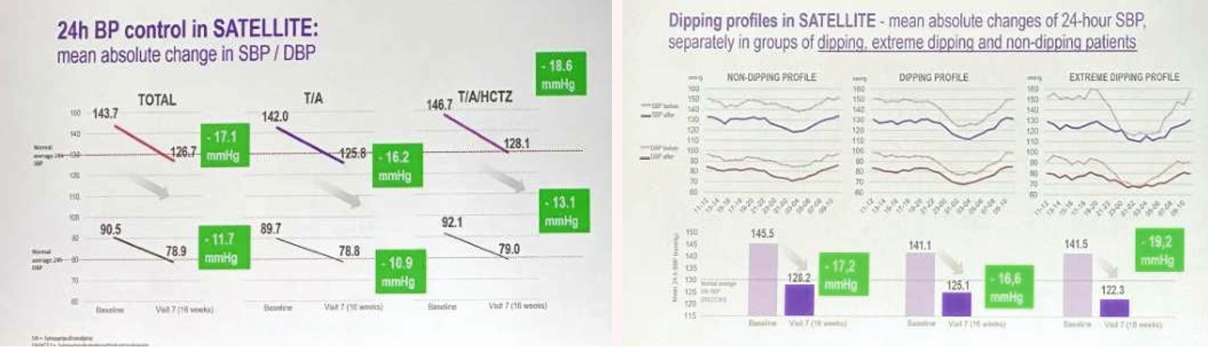
- Dipping profiles: non-dipping 55.1%, dipping 37.7%, extreme dipping 7.2%.
Baseline Characteristics:
- Mean 24-hour SBP/DBP: 143.7/90.5 mmHg.
Key Findings:
- Overall 16-week BP reduction: −17.1/−11.7 mmHg.
- T/A: −16.2/−10.9 mmHg.
- T/A/HCTZ: −18.6/−13.1 mmHg.
- Reductions consistent across all dipping subgroups.
- Office BP <140/90 mmHg achieved in ~89% of patients.
- Strict ABPM targets:
- 24-hour <130/80 mmHg: 44–50%.
- Daytime <135/85 mmHg: 55–57%.
- Nocturnal <125/75 mmHg: 31–33%.
ARV Improvements:
- ΔARVs −1.1 (SD 2.4 mmHg), ΔARVd −0.7 (SD 1.7 mmHg).
- 60% achieved >0.5 mmHg ARV reduction (61% T/A; 52% T/A/HCTZ).
Clinical Implications:
- T/A and T/A/HCTZ SPCs significantly reduce 24-hour BP and ARV across dipping profiles.
- ARV improvement in 60% of patients demonstrates a previously underappreciated benefit of SPC-based therapy.
- Nocturnal BP remains the most challenging target, suggesting potential need for future quadruple SPC strategies.
SATELLITE confirms that SPC therapy effectively reduces both BP and variability, highlighting additional benefits beyond office measurements and supporting more comprehensive hypertension management strategies.