
by Prateek Chopra | May 25, 2026 | Cardiology Conferences | ESC-HF 2026
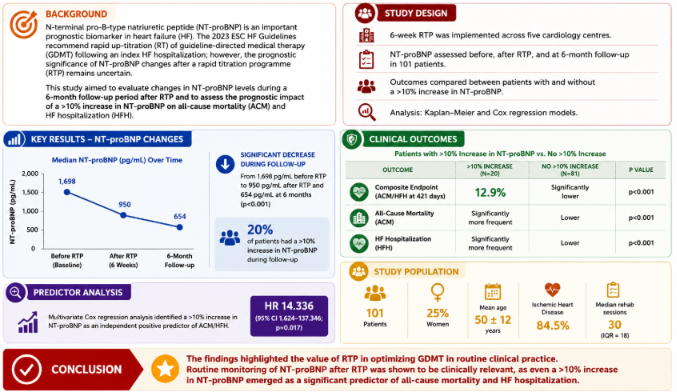
N-terminal pro-B-type natriuretic peptide (NT-proBNP) is an important prognostic biomarker in heart failure (HF). The 2023 ESC HF Guidelines recommend rapid up-titration (RT) of guideline-directed medical therapy (GDMT) following an index HF hospitalization; however, the prognostic significance of NT-proBNP changes after a rapid titration programme (RTP) remains uncertain. The study aimed to evaluate changes in NT-proBNP levels during a 6-month follow-up period after RTP and to assess the prognostic impact of a >10% increase in NT-proBNP on all-cause mortality (ACM) and HF hospitalization (HFH). The findings were presented at Heart Failure 2026, organized by the European Society of Cardiology, held in Barcelona, Spain, from 9–12 May 2026.
A 6-week RTP was implemented across five cardiology centres, with NT-proBNP assessed before, after RTP, and at 6-month follow-up in 101 patients. Clinical outcomes were compared between patients with and without a >10% increase in NT-proBNP using Kaplan-Meier and Cox regression analyses.
Median NT-proBNP levels decreased significantly during follow-up, from 1698 pg/mL before RTP to 950 pg/mL after RTP and 654 pg/mL at 6 months (p<0.001). Following completion of the RTP, 20% of patients demonstrated a >10% increase in NT-proBNP during follow-up. No significant differences were observed between groups regarding the proportion of patients achieving target doses of GDMT. During a median follow-up of 421 days, the composite endpoint of ACM/HFH occurred significantly more frequently among patients with a >10% increase in NT-proBNP compared with those without such an increase (25% vs 1%, p<0.001). Multivariate Cox regression analysis identified a >10% increase in NT-proBNP as an independent positive predictor of ACM/HFH (HR 14.336; 95% CI 1.624–137.346; p=0.017).
The findings highlighted the value of RTP in optimizing GDMT in routine clinical practice. Routine monitoring of NT-proBNP after RTP was shown to be clinically relevant, as even a >10% increase in NT-proBNP emerged as a significant predictor of all-cause mortality and HF hospitalization.