
by Prateek Chopra | June 11, 2026 | Diabetes Conferences | ADA 2026 | 0 comments
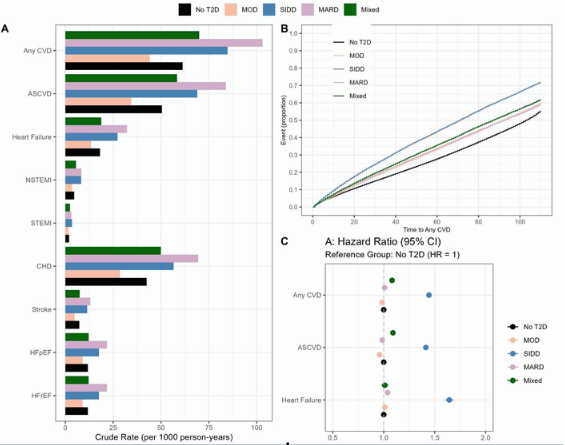
Study Design:
- This study evaluated rates of atherosclerotic cardiovascular disease (ASCVD) and heart failure (HF) across type 2 diabetes (T2D) subtypes compared with matched adults without diabetes.
- Adults aged ≥40 years with newly diagnosed T2D between 2012 and 2023 and no prior cardiovascular disease history were identified from the Epic Cosmos database (n=1,044,421).
- Individuals with T2D were matched 1:2 on age, sex, and BMI to adults without diabetes.
T2D Subtype Classification:
- Mild Obesity-Related Diabetes (MOD): 25%
- Severe Insulin-Deficient Diabetes (SIDD): 22%
- Mild Age-Related Diabetes (MARD): 39%
- Subtypes were identified using validated classification models (AUC: 0.81–0.99).
Population Characteristics:
- Mean age: 64.6 years
- Female: 52%
- Mean BMI: 33.4 kg/m²
- Median follow-up: 4 years (range: 1–12 years)
Cardiovascular Outcomes:
- Any cardiovascular disease: 278,463 cases
- ASCVD: 228,065 cases
- Heart failure: 83,556 cases
Key Findings:
- All T2D subtypes exhibited higher cardiovascular disease rates compared with matched adults without diabetes.
- Severe Insulin-Deficient Diabetes (SIDD) demonstrated the highest rates of both ASCVD and HF among all T2D subtypes.
- The excess cardiovascular risk associated with SIDD was evident when compared with both non-diabetic individuals and other T2D subtypes.
Clinical Implications:
- Cardiovascular risk is not uniform across T2D subtypes.
- Subtype classification may help identify individuals who require closer cardiovascular monitoring and more intensive preventive strategies.
Although all T2D subtypes were associated with increased cardiovascular risk, Severe Insulin-Deficient Diabetes (SIDD) carried the highest burden of ASCVD and heart failure. These findings support the use of diabetes subtype classification to improve cardiovascular risk stratification and guide targeted prevention eorts in clinical practice.