
by Prateek Chopra | June 11, 2026 | Diabetes Conferences | ADA 2026 | 0 comments
Need for Improved Risk Assessment:
- Cardiovascular disease (CVD) remains the leading cause of morbidity and mortality among people with diabetes, highlighting the need for accurate risk prediction tools to guide preventive strategies.
- Traditional risk assessment has relied on the 2013 Pooled Cohort Equations (PCE), which estimate 10-year risk of a first atherosclerotic cardiovascular disease (ASCVD) event but do not adequately account for heart failure (HF), chronic kidney disease (CKD), or diabetes-specific cardiovascular risk.
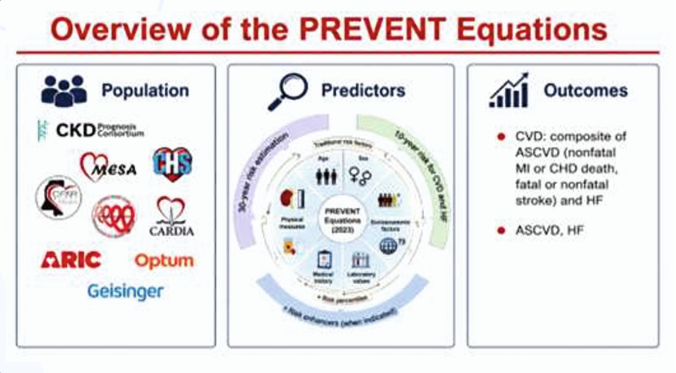
PREVENT Risk Equations:
- PREVENT was developed using contemporary cohorts and incorporates a broader range of cardiometabolic risk factors.
- The model predicts both ASCVD and HF outcomes.
- External validation demonstrated strong predictive performance, with C-statistics ranging from 0.736 to 0.830 and calibration slopes close to 1.0 across sexes.
Diabetes and CKD-Specific Risk Stratification:
- Estimated 10-year CVD risk was:
- 2.7% in individuals without diabetes or CKD.
- 6.2% in individuals with diabetes alone.
- 5.3% in individuals with CKD alone.
- 11.8% in individuals with both diabetes and CKD.
- PREVENT also provides 30-year risk estimates and risk percentiles to support earlier preventive interventions.
SCORE2-Diabetes Model:
- SCORE2 and SCORE2-Diabetes were developed and validated using large European populations.
- SCORE2-Diabetes incorporates diabetes-specific variables, including:
- Age at diabetes diagnosis.
- HbA1c levels.
- Estimated glomerular filtration rate (eGFR).
- The model was developed using data from approximately 230,000 individuals with type 2 diabetes and externally validated in more than 217,000 participants.
- SCORE2-Diabetes improves classification of individuals into moderate-, high-, and very-high-risk cardiovascular categories.
Validation and Clinical Relevance:
- Multinational validation across 6.4 million individuals demonstrated overall C-statistics of approximately 0.70 for PREVENT and 0.68 for SCORE2.
- Both models provide more comprehensive and contemporary cardiovascular risk assessment than traditional PCE-based approaches.
PREVENT and SCORE2-Diabetes represent important advances in cardiovascular risk prediction for people with diabetes. By incorporating diabetes-specific factors and broader cardiometabolic risk profiles, these models enable more precise risk stratification and support personalized cardiovascular prevention strategies