
by Prateek Chopra | May 24, 2026 | Cardiology Conferences | ESC-HF 2026
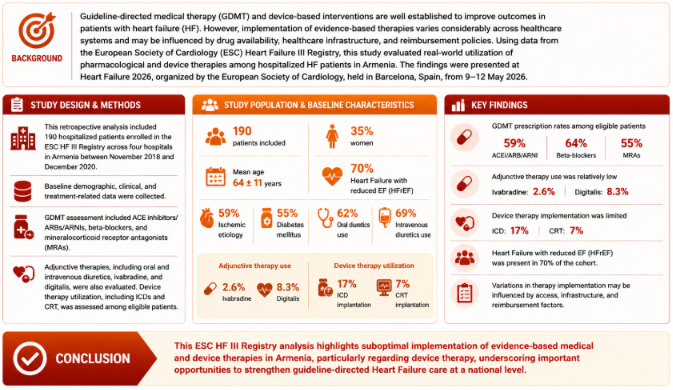
Guideline-directed medical therapy (GDMT) and device-based interventions are well established to improve outcomes in patients with heart failure (HF). However, implementation of evidence-based therapies varies considerably across healthcare systems and may be influenced by drug availability, healthcare infrastructure, and reimbursement policies. Using data from the European Society of Cardiology (ESC) Heart Failure III Registry, this study evaluated real-world utilization of pharmacological and device therapies among hospitalized HF patients in Armenia. The findings were presented at Heart Failure 2026, organized by the European Society of Cardiology, held in Barcelona, Spain, from 9–12 May 2026.
This retrospective analysis included 190 hospitalized patients enrolled in the ESC HF III Registry across four hospitals in Armenia between November 2018 and December 2020. Baseline demographic, clinical, and treatment-related data were collected. GDMT assessment included the use of ACE inhibitors/ARBs/ARNIs, beta-blockers, and mineralocorticoid receptor antagonists (MRAs). Adjunctive therapies, including oral and intravenous diuretics, ivabradine, and digitalis, were also evaluated. Device therapy utilization, including implantable cardioverter-defibrillators (ICDs) and cardiac resynchronization therapy (CRT), was assessed among eligible patients.
The study population had a mean age of 64±11 years, with women accounting for 35% of patients. Heart Failure with reduced ejection fraction (HFrEF) was present in 70% of the cohort. Among eligible patients, ACEi/ARB/ARNI therapy was prescribed in 59%, beta-blockers in 64%, and MRAs in 55%. Oral and intravenous diuretics were utilized in 62% and 69% of patients, respectively. Ivabradine and digitalis use remained relatively low at 2.6% and 8.3%, respectively. Device therapy implementation was notably limited, with ICD and CRT implantation rates of only 17% and 7% among eligible patients.
This ESC HF III Registry analysis highlights suboptimal implementation of evidence-based medical and device therapies in Armenia, particularly regarding device therapy, underscoring important opportunities to strengthen guideline-directed Heart Failure care at a national level.