
by Prateek Chopra | May 30, 2026 | Cardiology Conferences | ESC-HF 2026
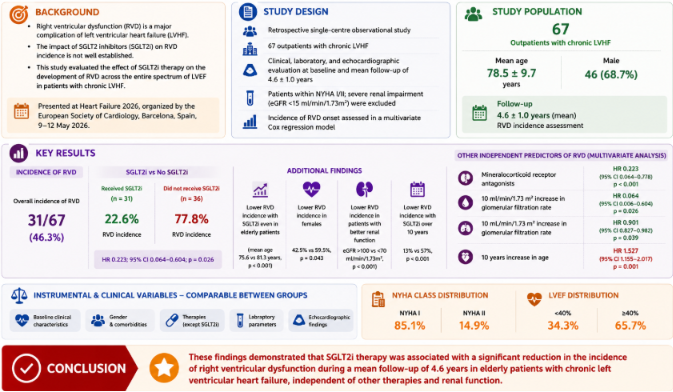
Right ventricular dysfunction (RVD) is a major complication of left ventricular heart failure (LVHF), and although neurohormonal modulation improves prognosis in LVHF, its impact on reducing RVD incidence remains limited. Data regarding the association between sodium-glucose cotransporter 2 inhibitors (SGLT2i) and RVD incidence are currently lacking. This study evaluated the prognostic impact of SGLT2i therapy on the development of RVD across the entire spectrum of ejection fraction (EF) in patients with chronic LVHF, with RVD defined as Tricuspid Annular Plane Systolic Excursion (TAPSE) <17 mm. The findings were presented at Heart Failure 2026, organized by the European Society of Cardiology, held in Barcelona, Spain, from 9–12 May 2026.
In this retrospective single-centre observational study, 467 outpatients with chronic LVHF, with a mean age of 78.5±9.7 years, underwent clinical, laboratory, and echocardiographic evaluation during a mean follow-up of 4.6±1.0 years. Patients with HF NYHA IV, worsening HF within the previous 6 months, baseline TAPSE <17 mm, or eGFR <15 mL/min/1.73m² were excluded. Variables significantly associated with RVD onset were included in a multivariate Cox regression model to determine hazard ratios for incident RVD.
Among the study population, 231 patients received SGLT2i therapy and 236 did not. Both groups were comparable regarding gender, major comorbidities, therapies, laboratory findings, and instrumental variables. Patients receiving SGLT2i were younger, with a mean age of 75.6±9.3 years versus 81.3±9.3 years (p<0.0001), and had lower EF values, with a mean EF of 42.5±9.5% compared with 47.1±8.1% (p<0.0001). The overall incidence of RVD was 4.8 events/100 patients-year, including 1.3 events/100 patients-year in the SGLT2i group and 7.8 events/100 patients-year in the non-SGLT2i group (p<0.0001). Multivariate analysis demonstrated that SGLT2i therapy (HR 0.223; p<0.0001), mineralocorticoid receptor antagonists (HR 0.604; p<0.026), and a 10 mL/min/1.73 m² increase in glomerular filtration rate (HR 0.901; p<0.039) were associated with lower risk of RVD, whereas an increase in age of 10 years was associated with higher RVD risk (HR 1.527; p<0.001).
These findings demonstrated that SGLT2i therapy was associated with a significant reduction in the incidence of right ventricular dysfunction during 4.6 years of follow-up in elderly patients with chronic left ventricular heart failure.