
by Prateek Chopra | May 27, 2026 | Cardiology Conferences | ESC-HF 2026
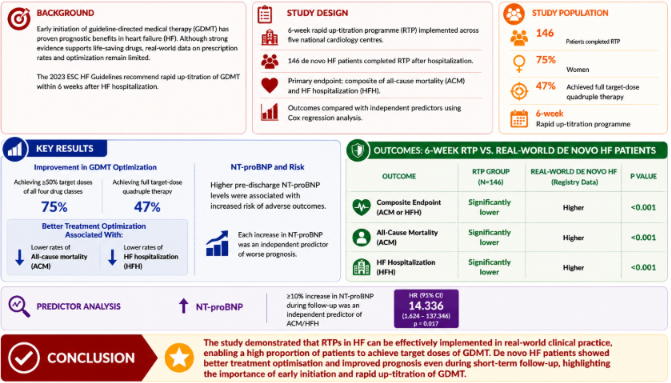
Early initiation of guideline-directed medical therapy (GDMT) has shown significant prognostic benefits in heart failure (HF). Despite strong evidence for life-saving drug therapy, previous real-world registries of chronic HF patients have consistently revealed low prescription rates and underdosing of GDMT. Accordingly, the 2023 ESC HF guidelines recommend rapid up-titration of GDMT within 6 weeks after HF hospitalisation, based on the STRONG-HF trial. The study assessed the application of GDMT after a 6-week rapid titration programme (RTP) among de novo and non-de novo HF patients and evaluated the prognostic all-cause mortality (ACM) and HF hospitalisation (HFH) differences among these subgroups. The findings were presented at Heart Failure 2026, organized by the European Society of Cardiology, held in Barcelona, Spain, from 9–12 May 2026.
In line with the 2023 ESC HF guidelines, a 6-week rapid up-titration programme (RTP) was implemented across five national cardiology centres. This analysis included 146 HF patients completing RTP after HF hospitalisation and evaluated the composite endpoint of all-cause mortality (ACM) and HF hospitalisation (HFH), along with their independent predictors using Cox regression analysis.
Following the 6-week RTP, GDMT optimisation improved markedly, with 75% of patients achieving ≥50% target doses of quadruple therapy and 47% of patients achieving full target-dose quadruple therapy. De novo HF patients showed better treatment optimisation and lower rates of all-cause mortality (ACM) and HF hospitalisation (HFH), while diabetes and higher pre-discharge NT-proBNP levels were associated with increased risk of adverse outcomes.
The study demonstrated that RTPs in HF can be effectively implemented in real-world clinical practice, enabling a high proportion of patients to achieve target doses of GDMT. Furthermore, de novo HF diagnosis was associated with better treatment optimisation and improved prognosis even during short-term follow-up, highlighting the importance of early initiation and rapid up-titration of GDMT.