
by Prateek Chopra | June 3, 2026 | Cardiology Conferences | ESC-HF 2026
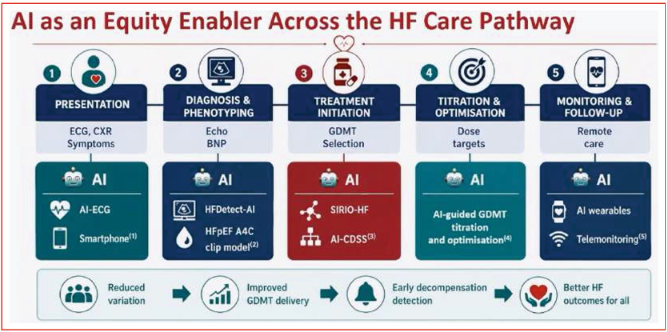
Artificial intelligence (AI) was discussed as a promising approach to address inequities in heart failure care. Persistent disparities in diagnosis, treatment, and outcomes arise from differences in access to specialists, healthcare infrastructure, and adherence to evidence-based therapies. AI was presented as a tool capable of analyzing large volumes of clinical, imaging, laboratory, and wearable-device data to facilitate earlier diagnosis, risk stratification, and personalized treatment recommendations. The findings were presented at Heart Failure 2026, organized by the European Society of Cardiology, held in Barcelona, from 9–12 May 2026.
Current and emerging applications of AI in heart failure management were reviewed. The discussion focused on machine learning algorithms integrated with electronic health records, imaging modalities, and remote monitoring systems. Their ability to support clinical decision-making, predict adverse outcomes, and standardize evidence-based care across different healthcare settings was evaluated.
AI was shown to improve the identification of high-risk patients, predict hospitalization and readmission, and enable early detection of clinical deterioration. Automated decision-support tools were described as enhancing adherence to guideline-directed medical therapy and reducing therapeutic inertia. Remote monitoring and predictive analytics were highlighted as extending expert-level care to underserved and geographically remote populations. These capabilities were considered likely to reduce variability in care and improve outcomes across diverse patient groups.
AI was portrayed as a powerful equalizer in heart failure care. By supporting timely diagnosis, optimizing treatment, and expanding access to specialized expertise, AI has the potential to reduce disparities and promote more equitable care. Its success, however, depends on the use of representative datasets, transparent algorithm development, and responsible clinical implementation.