
by Prateek Chopra | June 10, 2026 | Cardiology Conferences | ESH 2026
Treatment Challenge:
The 2018 ESC/ESH guidelines introduced stricter systolic BP targets (120–129 mmHg) and stepwise escalation from dual to triple therapy. Evidence for achieving <130 mmHg in patients on ≥3 antihypertensive drugs remains limited. The OPTIMAL-HT study evaluates triple single-pill combination therapy (SPC) for stringent BP control and explores fourth-line strategies for resistant hypertension.
Study Objectives:
- Primary: Confirm true uncontrolled hypertension, evaluate triple SPC effectiveness, and identify optimal fourth-line therapy for resistant hypertension.
- Secondary: Assess BP measurement concordance (office, home, ambulatory), evaluate adherence, identify predictors of treatment response, and measure quality-of-life impact.
Patient Population:
- Adults aged 18–75 years with hypertension for ≥6 months.
- Uncontrolled office BP ≥130/80 mmHg despite ≥3 antihypertensive drugs (including ACEi/ARB + diuretic).
- Stable treatment regimen for ≥4 weeks.
Key Findings:
Phase A (ABPM Monitoring):
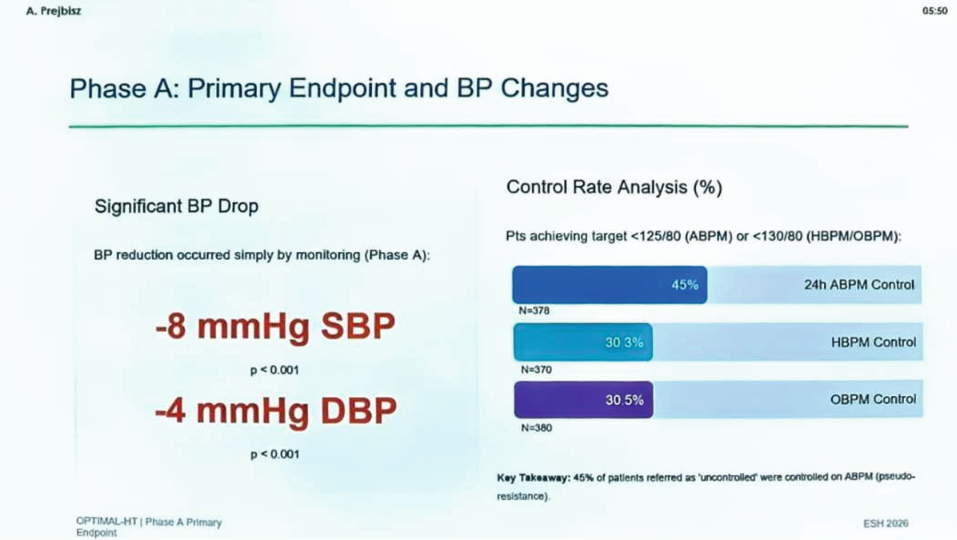
- BP monitoring alone reduced BP by 8/4 mmHg.
- 45% of patients labeled as uncontrolled were actually controlled (pseudo-resistance).
Phase B (Triple SPC Intervention):
- BP reductions across ambulatory, office, home, and nighttime measurements, up to 11/5 mmHg.
- Favorable safety profile; increased dizziness and hypotension, no significant rise in other adverse effects.
- Quality-of-life improvements: reductions in depression and insomnia scores, enhanced overall well-being.
Managing difficult-to-control hypertension requires optimized single-pill combinations. ABPM is essential to detect pseudo-resistant hypertension and guide treatment. Switching to triple SPCs improves adherence, simplifies therapy, enhances BP control, and delivers meaningful improvements in patient outcomes.