
by Prateek Chopra | May 14, 2026 | Cardiology Conferences | ESC-HF 2026
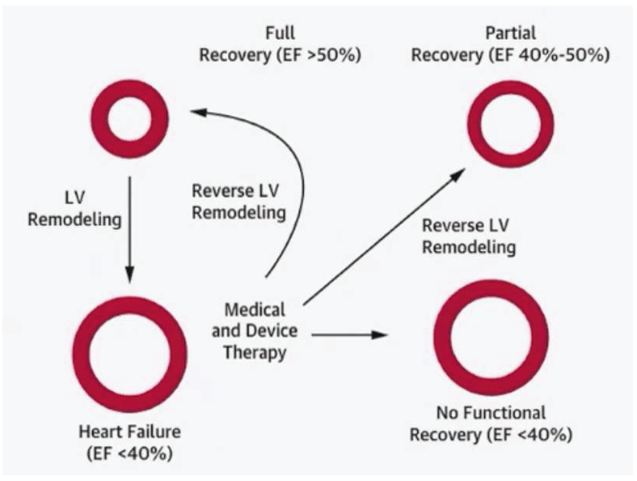
Heart failure phenotypes characterized by improvement or recovery in le ventricular ejec on frac on (LVEF) have emerged as important clinical en es, leading to the evolving concepts of heart failure with improved ejec on frac on (HFimpEF), heart failure with recovered heart failure (HFrecHF/HFrecEF), and heart failure in remission (HFremEF). Earlier defini ons of HFrecEF described pa ents with baseline LVEF <40%, followed by an absolute improvement of ≥10% and a subsequent LVEF >40%, reflec ng reverse le ventricular remodeling a er guideline-directed medical and device therapy. The findings were presented at Heart Failure 2026, organized by the European Society of Cardiology, held in Barcelona, from 9–12 May 2026.
The 2021 Universal Defini on of Heart Failure replaced HFrecEF with HFimpEF, emphasizing a clinically meaningful increase in LVEF of >10%, usually from ≤40% to >40%, while recognizing inter- and intra-observer variability of 5–10% in LVEF assessment. John Cleland and colleagues highlighted that pa ents may achieve par al recovery (LVEF 40–50%) or full recovery (LVEF >50%), o en accompanied by reverse le ventricular remodeling following opmal medical and device therapy. However, improvement in LVEF does not necessarily indicate complete myocardial recovery or cure, and relapse may s ll occur despite apparent func onal normaliza on.
Registry data show that HFimpEF is more frequently observed in younger pa ents and women. In the OPT-HF registry, improvement to LVEF >50% occurred in 17% of ischemic cardiomyopathy pa ents and 30% of dilated cardiomyopathy pa ents within 1 year. Predictors of HFimpEF include younger age, shorter HF dura on, non-ischemic e ology, narrower QRS dura on, and adherence to therapy. The CHRISTMAS study further demonstrated that pa ents with ischemic cardiomyopathy and hiberna ng myocardium treated with carvedilol showed significant improvement in LVEF compared with placebo, suppor ng the reversibility of myocardial dysfunc on with opmized therapy. Contemporary concepts of heart failure trajectories integrate three major domains: cardiac dysfunc on, conges on, and symptoms. Resolu on of conges on, o en reflected by withdrawal of loop diure cs, has been proposed as an important marker of symptoma c remission and favorable prognosis.
HFremEF represents a stricter phenotype requiring resolu on of symptoms and signs, normaliza on of LVEF and cardiac volumes, normaliza on of biomarkers such as NT-proBNP and troponin, and sustained recovery, par cularly in reversible condi ons such as peripartum or tachycardia-induced cardiomyopathy.
The concept of remission emphasizes that some patients may become asymptomatic and free from congestion while residual cardiac dysfunction persists. Despite improvement or remission, patients remain at risk for relapse, highlighting the importance of continued surveillance and individualized long-term guideline-directed therapy.