
by Prateek Chopra | May 15, 2026 | Cardiology Conferences | ESC-HF 2026
Patients with heart failure with reduced ejection fraction (HFrEF) continued to experience substantial morbidity and mortality despite contemporary guideline-directed medical therapy (GDMT). The prognosis after worsening heart failure (HF) events remained poor, with approximately 37% 1-year all-cause mortality/HFH rates and 19% 1-year mortality despite optimized medical and device therapy. Dysregulation of the nitric oxide–soluble guanylate cyclase–cyclic guanosine monophosphate (NO–sGC–cGMP) pathway was recognized as an important contributor to HF progression. Vericiguat, an oral soluble guanylate cyclase stimulator, was evaluated as an adjunctive therapy to reduce residual cardiovascular risk in HFrEF.
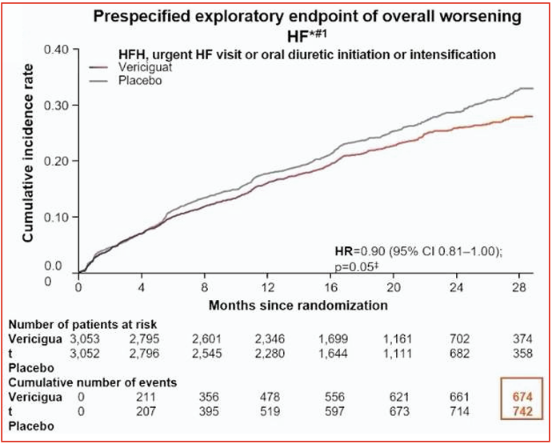
Evidence from the phase III VICTORIA and VICTOR-HF trials and related analyses was reviewed. VICTORIA was a randomized, double-blind, placebo-controlled trial that enrolled patients with chronic symptomatic HFrEF and recent worsening HF. The primary endpoint was a composite of cardiovascular (CV) death or first HF hospitalization (HFH). VICTOR-HF further evaluated vericiguat in ambulatory patients with chronic HFrEF receiving contemporary GDMT, including patients on quadruple therapy. Outcomes included HFH, CV death, all-cause mortality, and worsening HF events requiring oral or intravenous diuretic intensification.
In the VICTORIA trial, vericiguat significantly reduced the primary composite endpoint of first HFH or CV death compared with placebo (HR=0.90; 95% CI 0.82–0.98; p=0.02), with an absolute risk reduction of 4.2 events/100 patient-years and an annual number needed to treat of 24. Among patients with NT-proBNP ≤5,314 pg/mL, vericiguat reduced first HFH or CV death (HR=0.78; p<0.001), CV death (HR=0.78; p=0.011), all-cause mortality (HR=0.82; p=0.021), and total HFH (HR=0.80; p<0.001). In VICTOR-HF, vericiguat significantly reduced CV death (HR=0.83; 95% CI 0.71–0.97; p=0.02) and all-cause mortality (HR=0.84; 95% CI 0.74–0.97; p=0.015), although reductions in the primary composite endpoint and HFH alone were not statistically significant. Vericiguat was generally well tolerated, with safety outcomes comparable to placebo.
Vericiguat demonstrated clinically meaningful reductions in worsening HF events and mortality in selected patients with chronic HFrEF despite optimized GDMT. The findings suggested that targeting the NO–sGC–cGMP pathway with vericiguat may help address residual cardiovascular risk across the HFrEF disease spectrum.