
by Prateek Chopra | May 28, 2026 | Cardiology Conferences | ESC-HF 2026
Long-term modulation of lipid metabolism with angiotensin receptor–neprilysin inhibition in heart failure with reduced ejection fraction remains incompletely characterised, despite evidence suggesting metabolic effects mediated through neprilysin inhibition and enhanced natriuretic peptide signalling. This study evaluated the longitudinal effects of sacubitril/valsartan on lipid parameters and N-terminal pro-B-type natriuretic peptide (NT-proBNP) concentrations over 3 years in symptomatic heart failure with reduced ejection fraction. The findings were presented at Heart Failure 2026, organized by the European Society of Cardiology, held in Barcelona, Spain, from 9–12 May 2026.
A retrospective cohort of adults receiving sacubitril/valsartan for symptomatic heart failure with reduced ejection fraction was evaluated. Lipid parameters and NT-proBNP concentrations were assessed at baseline and serial follow-up visits for up to 36 months. Analyses were performed in the overall cohort and stratified according to statin exposure, with repeated-measure statistics used for comparison against baseline values.
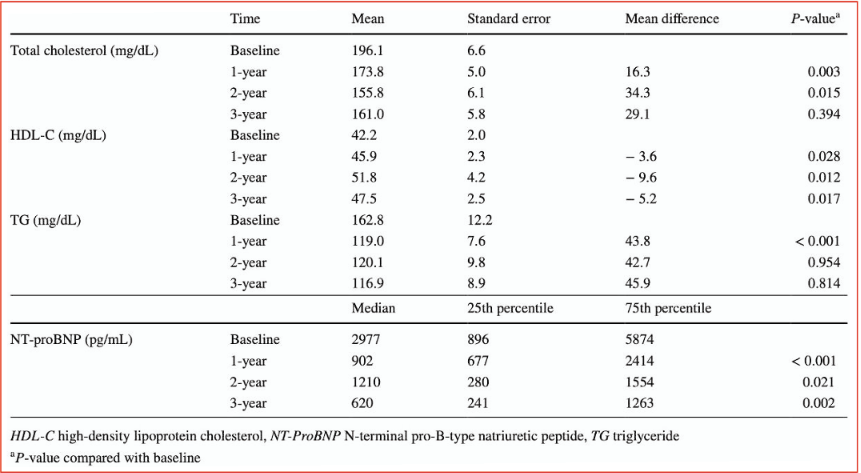
A total of 192 patients were included. Sacubitril/valsartan therapy was associated with progressive reductions in total cholesterol from 196.1 ± 44.8 to 161.5 ± 41.7 mg/dL at year 3 and triglycerides from 159.1 ± 10.4 to 121.4 ± 6.9 mg/dL, with sustained improvement versus baseline (all p<0.001). High-density lipoprotein cholesterol increased during follow-up from 44.9 ± 17.1 to 48.2 ± 2.4 mg/dL at year 3 (p<0.001). NT-proBNP concentrations decreased consistently over time from 3916 to 882 pg/mL (p<0.001). Similar directional trends were observed in both statin-treated and statin-free subgroups, suggesting metabolic effects independent of concurrent lipid-lowering therapy.
These findings demonstrated that sacubitril/valsartan was associated with favourable long-term modulation of lipid metabolism, including reductions in total cholesterol and triglycerides, improvement in high-density lipoprotein cholesterol, and significant reductions in NT-proBNP over 3 years in symptomatic heart failure with reduced ejection fraction. The observed metabolic effects may represent complementary benefits of neprilysin inhibition beyond neurohormonal modulation and could contribute to long-term cardiovascular risk reduction.