
by Prateek Chopra | June 2, 2026 | Cardiology Conferences | ESH 2026
Prognostic Significance of BP Variability:
Blood pressure variability (BPV) is an important and modifiable cardiovascular risk marker beyond mean BP. Higher visit-to-visit systolic BP variability is linked to increased risks of CVD, stroke, heart failure, CKD, dementia, and all-cause mortality.
Evidence:
- Pooled analyses, meta-analyses, and real-world studies consistently demonstrate the prognostic significance of BPV.
- SPRINT and ACCORD trials: Nonlinear, J-shaped relationship; higher BPV associated with significantly worse cardiovascular outcomes.
- Long-term observational studies (>36,000 participants) confirm persistently elevated BPV increases risks of CVD, CKD, dementia, and mortality.
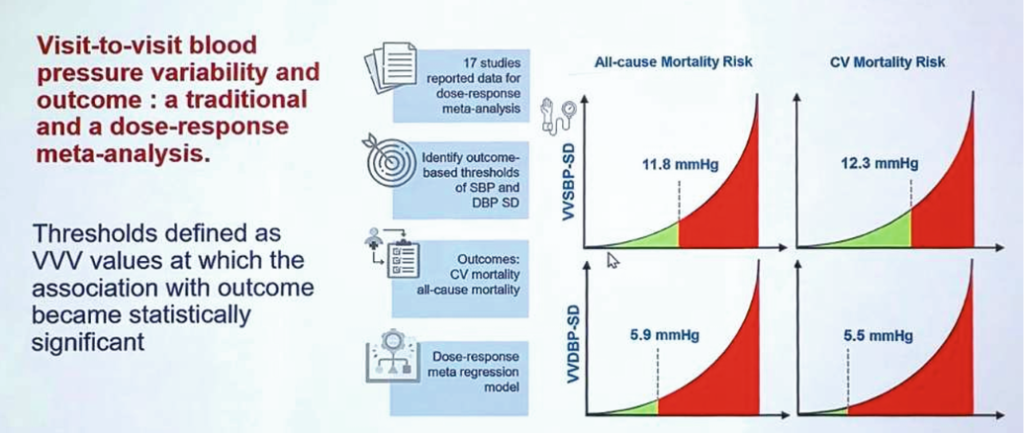
- Dose-response meta-analysis:
- Systolic BP variability thresholds for all-cause mortality: 11.8 mmHg; cardiovascular mortality: 12.3 mmHg.
- Diastolic BP variability thresholds: 5.9 mmHg (all-cause), 5.5 mmHg (CV mortality).
- BPV assessment includes office BP, home BP monitoring, and ABPM, categorized by time domain: within-beat, short-term, mid-term, and long-term.
- Emerging evidence links higher BPV to cognitive decline and dementia, independent of antihypertensive adherence or drug class.
Clinical Implications:
- BPV should be routinely considered alongside mean BP in hypertension management.
- Early identification and interventions aimed at smoother BP control may reduce long-term cardiovascular and cognitive risks.
Monitoring and managing BP variability adds prognostic value for both cardiovascular and non-cardiovascular outcomes, highlighting the need for strategies that achieve more stable, controlled BP profiles in patients with hypertension.