
by Prateek Chopra | June 9, 2026 | Cardiology Conferences | ESH 2026
Enhanced Adherence and Persistence:
- Non-adherence increases with higher pill burden.
- SPCs consistently demonstrate better adherence and persistence compared with free-drug combinations across randomized trials and real-world studies.
Blood Pressure Reduction:
- Analysis of 354 randomized trials showed superior BP reduction with low-dose combination therapy across major antihypertensive classes: thiazides, ACE inhibitors, CCBs, beta-blockers, and ARBs.
- Meta-analysis of RCTs:
- Two-drug combinations: systolic BP reduced by 24 mmHg (21–35).
- Three-drug combinations: systolic BP reduced by 26 mmHg (22–28).
- SPCs achieve more rapid and consistent BP control than free-drug combinations.
Cardiovascular Outcomes & Mortality:
- SPCs provide superior cardiovascular protection and lower mortality compared with free combinations.
- Hazard ratios from trials:
- Ramipril/amlodipine: 0.80 (0.77–0.83).
- Valsartan/amlodipine/HCTZ: 0.68 (0.61–0.74).
- Candesartan/amlodipine: 0.77 (0.65–0.90).
- Valsartan/amlodipine: 0.87 (0.84–0.91).
Real-World Cost and Implementation:
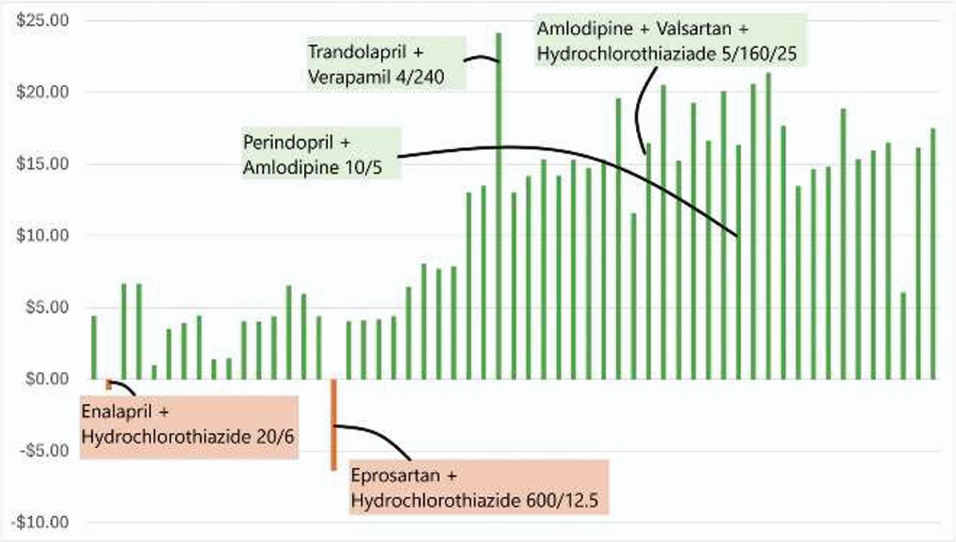
- SPC therapy reduces healthcare costs for patients and healthcare systems.
- Cost-saving benefits observed across 57 available SPC regimens.
- Perindopril-based SPCs show improved adherence and outcomes in practice.
- International guidelines (2023 WHF Roadmap, AHA Scientific Statement) emphasize SPC implementation to improve BP control, adherence, CV protection, and stroke prevention, without increasing treatment discontinuation.
Single-pill combinations represent an effective, evidence-based, and cost-efficient strategy for hypertension management. They consistently improve adherence, accelerate BP control, reduce cardiovascular and stroke events, and lower healthcare costs compared with free-drug combinations, supporting broader implementation in clinical practice.