
by Prateek Chopra | June 5, 2026 | Cardiology Conferences | ESH 2026
Emerging Paradigm:
Hypertension affects ~1.3 billion people worldwide, yet fewer than 25% achieve adequate BP control. Poor medication adherence, especially with polypharmacy, remains a critical barrier. This review explores whether hypertension therapy requires reinvention and evaluates emerging pharmacological, device-based, and AI-driven strategies poised to transform care by 2036.
Emerging Therapies and Technologies:
- Aldosterone Synthase Inhibitors (ASIs): Baxdrostat (FDA-approved 2026) reduced systolic BP by −14.5 mmHg (1 mg) and −15.7 mmHg (2 mg) versus −5.8 mmHg placebo (p<0.001).
- Device-Based Interventions:
- Renal denervation: durable BP reductions up to −35 mmHg at 36 months (SYMPLICITY HTN-2).
- Baroreflex activation therapy: reductions of 5–10 mmHg with sustained effects for 2–5 years.
- RNA-Based and Gene Therapies: Early-to-preclinical development for hypertension.
- AI-Driven Systems: Closed-loop, continuous BP monitoring with automated microdosing of antihypertensives.
- WHO 80-80-80 Framework: Assessed as part of system-level strategies.
Projected Care Evolution:
- From intermittent BP measurements → continuous cardiovascular phenotyping.
- From empirical drug escalation → targeted biological interventions.
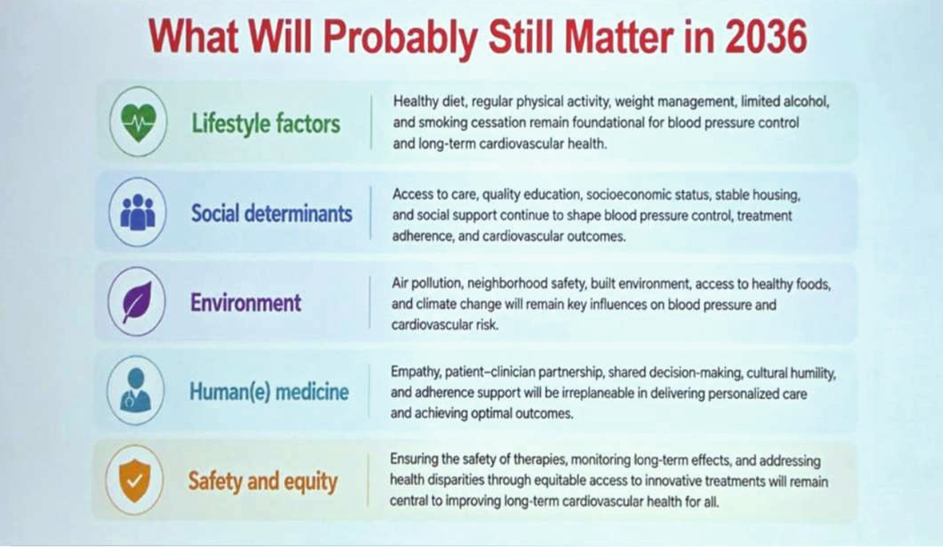
- Lifestyle modification, social determinants, and humane, patient-centered care remain foundational.
By 2036, hypertension management may focus not just on controlling BP, but achieving earlier, more precise, and equitable interventions through integrated pharmacological, device-based, and AI-guided strategies.