
by Prateek Chopra | June 26, 2026 | Diabetes Conferences | ADA 2026
Study Objective
- This pilot trial evaluated whether an SGLT2 inhibitor-based stepwise intensive therapy could achieve drug-free remission in newly diagnosed T2DM with severe hyperglycemia.
- The strategy was designed as a simplified alternative to prolonged inpatient short-term intensive insulin therapy (SIT).
Methods
- Sixty newly diagnosed T2DM patients were randomized 1:1 to:
- Group A: Stepwise intensive therapy (n=30).
- Group B: Conventional SIT (n=30).
- Group A received brief inpatient SIT followed by 8 weeks of outpatient treatment with insulin glargine, empagliflozin, metformin, and lifestyle management.
- Group B received 2–3 weeks of inpatient SIT.
- Participants were followed for 24 weeks after intervention.
Primary Endpoint
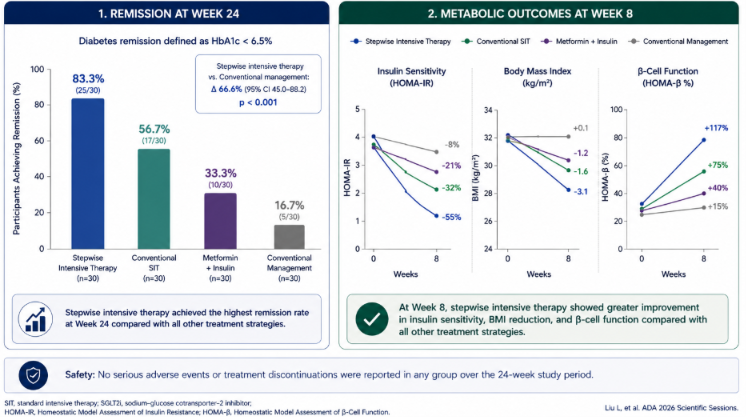
- Diabetes remission, defined as HbA1c <6.5% at Week 24.
Study Population
- Fifty-seven participants completed the study:
- Group A: 29 patients.
- Group B: 28 patients.
- Mean baseline HbA1c: 10.5 ± 1.5%.
Remission Outcomes
- Remission rates at Week 24 were comparable:
- Group A: 48.3%.
- Group B: 46.4%.
- No significant difference was observed between groups (P>0.05).
Metabolic Outcomes
- Group A demonstrated significantly better insulin sensitivity:
- Matsuda Index: 6.5 vs 4.5 (P<0.01).
- HOMA-IR: 2.3 vs 4.5 (P<0.01).
- Greater BMI reduction was observed in Group A:
- 24.4 ± 0.8 vs 25.7 ± 0.8 kg/m² (P=0.02).
- Improvements in β-cell function were observed in both groups.
Safety
- No serious adverse events occurred.
- No treatment discontinuations were reported.
SGLT2i-based stepwise intensive therapy achieved remission rates comparable to conventional SIT while providing greater improvements in insulin sensitivity and BMI. This simplified outpatient-oriented approach may offer a practical alternative to prolonged inpatient intensive insulin therapy for inducing remission in newly diagnosed T2DM.