
by Prateek Chopra | June 24, 2026 | Diabetes Conferences | ADA 2026
Clinical Significance
- Cardiovascular risk remains elevated in individuals with type 2 diabetes mellitus (T2DM), even when conventional lipid parameters appear normal.
- HDL functionality may be impaired despite normal HDL-cholesterol (HDL-C) levels.
- This study evaluated the relationship between ATP-binding cassette transporters (ABCA1 and ABCG1), HDL functionality, and atherosclerosis in T2DM.
Study Population
- Normal glucose tolerance (NGT): 47 participants.
- T2DM without atherosclerosis: 47 participants.
- T2DM with atherosclerosis (T2DM+A): 61 participants.
Methods
- Circulating ABCA1 and ABCG1 concentrations were measured using ELISA.
- HDL functionality was assessed using a macrophage cholesterol efflux assay.
- Correlation analyses, multinomial logistic regression, and ROC curve analyses were performed.
ABC Transporter Levels and HDL Functionality
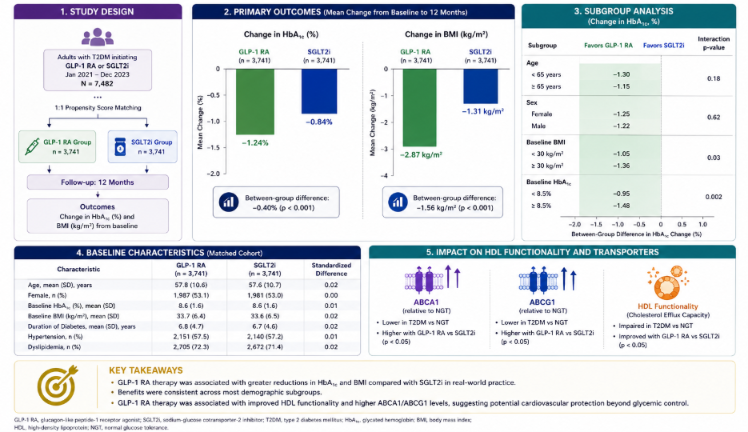
- Circulating ABCA1 and ABCG1 levels were significantly lower in both T2DM groups compared with individuals with normal glucose tolerance.
- Both transporters showed positive associations with cholesterol efflux capacity.
Impact on HDL Functionality
- HDL-C concentrations were similar across all study groups.
- Despite comparable HDL-C levels, HDL functionality was significantly impaired:
- NGT: 32.86±2.07
- T2DM: 29.72±1.75
- T2DM+A: 25.08±1.90
- The greatest impairment was observed in individuals with T2DM and atherosclerosis.
Discriminatory Performance
- ROC analysis demonstrated good predictive performance for identifying impaired HDL functionality and atherosclerotic risk:
- ABCA1 AUC: 0.782
- ABCG1 AUC: 0.752
Clinical Implications
- Reduced ABCA1 and ABCG1 levels may contribute to impaired cholesterol efflux and dysfunctional HDL in T2DM.
- Assessment of HDL functionality may provide additional cardiovascular risk information beyond conventional HDL-C measurements.
Individuals with T2DM, particularly those with atherosclerosis, exhibited impaired HDL functionality despite similar HDL-C levels. Lower circulating ABCA1 and ABCG1 levels were associated with reduced cholesterol efflux capacity, suggesting that these transporters may serve as useful biomarkers of HDL dysfunction and early atherosclerotic risk in T2DM.