
by Prateek Chopra | May 26, 2026 | Cardiology Conferences | ESC-HF 2026
Implantable hemodynamic monitoring has been associated with reduced heart failure (HF) hospitalizations through earlier detection of congestion and more individualized treatment adjustments. A patient self-management (PSM) strategy guided by physicians may further improve adherence, reduce dependence on frequent caregiver intervention, and enable timely optimization of therapy. The VECTOR-HF II pilot study evaluated the safety, usability, and performance of the V-LAP system combined with a physician-directed PSM approach in patients with chronic HF. The findings were presented at Heart Failure 2026, organized by the European Society of Cardiology, held in Barcelona, Spain, from 9–12 May 2026.
VECTOR-HF II is a prospective, international, multicenter, single-arm clinical trial enrolling NYHA class II and III HF patients irrespective of left ventricular ejection fraction. Under physician-directed PSM, physicians predefined left atrial pressure (LAP) thresholds that triggered self-adjustment of diuretic therapy when 5-day average LAP values deviated from the target range of 5–13 mmHg. Primary endpoints included successful LAP measurement acquisition and transmission to the healthcare provider interface and patient guidance application, along with safety outcomes.
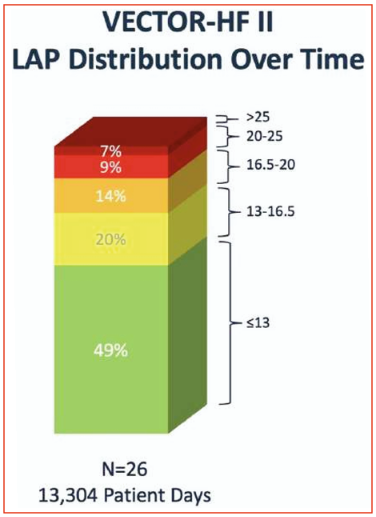
This preliminary analysis included 26 of 45 enrolled patients with a mean follow-up of 512 days. Mean age was 68.42 ± 7.63 years with 4 female patients and mean body mass index was 27.03 ± 4.49 kg/m2. As for mean left ventricular ejection fraction was 39.79 ± 15.18%, mean systolic pulmonary artery pressure was 34.68 ± 13.34 mmHg, and mean PCWP is 13.72 ± 6.72 mmHg. The V-LAP system demonstrated 100% freedom from failure in obtaining and transmitting LAP measurements. Freedom from study-related MACNE events at 3 months was also 100%. Patient compliance with the PSM strategy reached 96.40%, defined as at least 5 successful LAP measurements weekly. Analysis of 13,304 patient days showed that LAP remained below 13 mmHg for 49.30% of monitoring time, while HF hospitalizations declined from 0.57 to 0.20 events per patient-year after implantation, representing a 65% reduction.
The VECTOR-HF II pilot study demonstrated that physician-directed patient self-management using the V-LAP system was feasible, safe and associated with high compliance, effective pressure control, and reduced HF hospitalizations in patients with chronic HF.