
by Prateek Chopra | May 17, 2026 | Cardiology Conferences | ESC-HF 2026
Sacubitril–valsartan (SV) has demonstrated prognostic benefits in patients with heart failure with reduced ejection fraction (HFrEF), although its long-term impact in real-world clinical practice remains unclear. This study assessed long-term outcomes associated with SV use in a real-world HFrEF cohort. The findings were presented at Heart Failure 2026, organized by the European Society of Cardiology, held in Barcelona, Spain, from 9–12 May 2026.
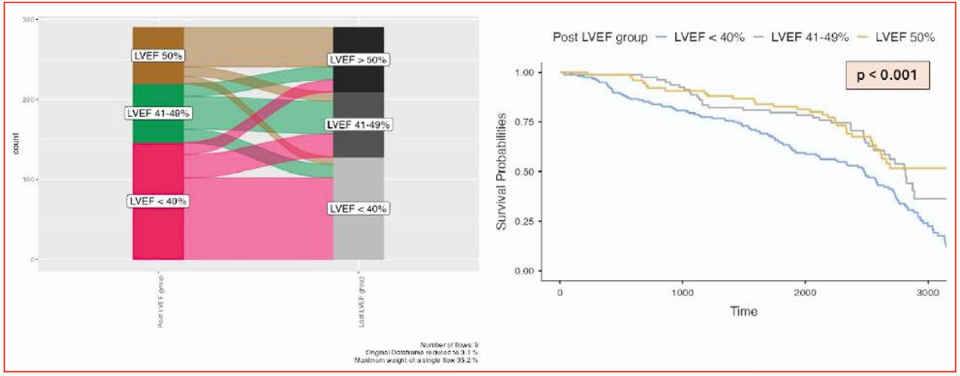
An observational study included patients with HFrEF who initiated SV between 2017 and 2019. Ventricular reverse remodelling was defined as an increase in LVEF >5% between baseline and follow-up echocardiography. Patients were categorized according to follow-up LVEF into ≤40%, 41–49%, and ≥50% groups. The primary endpoint was a composite of all-cause mortality, HF admission, and emergency department visits.
A total of 379 patients were included (mean age 69±12 years; 25% women). Ischemic etiology was present in 49% of patients, and most were in NYHA class II or III before SV initiation. Median baseline LVEF was 34%. Baseline therapy showed high use of beta blockers (84.1%) and MRA (68.6%), whereas SGLT2 inhibitor use remained low (19%). SV was predominantly initiated at lower doses (77.2%).
Ventricular reverse remodelling occurred in 54% of patients and was more common among younger patients, those with non-ischemic etiology, higher baseline LVEF, better renal function, and higher SV doses. Increasing follow-up LVEF categories were associated with progressive reduction in HF admission or death (p<0.001).
In this real-world HFrEF cohort, ventricular reverse remodelling after sacubitril–valsartan therapy was associated with fewer HF admissions and lower mortality, highlighting the importance of echocardiographic monitoring after treatment initiation.