
by Prateek Chopra | June 18, 2026 | Cardiology Conferences | ESH 2026
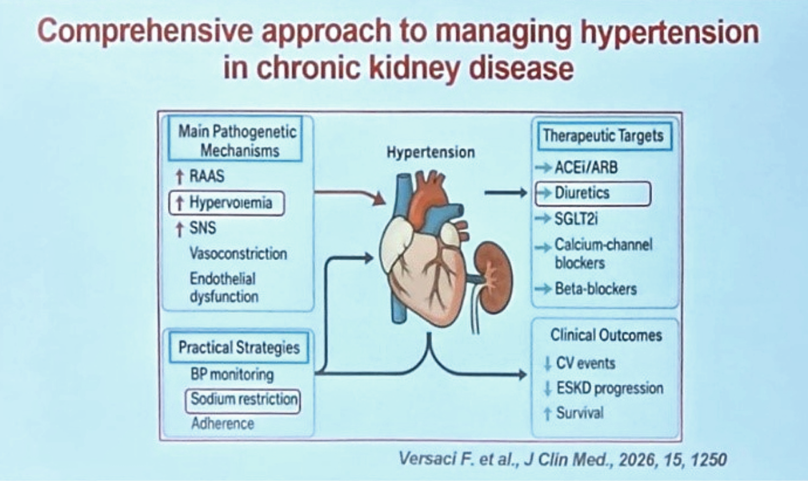
Clinical Background:
Hypertension in chronic kidney disease (CKD) arises from sodium retention, RAAS activation, sympathetic overactivity, and endothelial dysfunction. High dietary salt intake accelerates CKD progression via proteinuria and glomerular hyperfiltration, making diuretics central to hypertension management.
Evidence & Guideline Recommendations:
- Targets: SBP <130 mmHg, DBP <80 mmHg (ESH 2023).
- CKD Stages 1–3 (eGFR ≥30 mL/min/1.73 m²): Thiazide-type diuretics with ACEi/ARB and CCB preferred.
- CKD Stages 4–5: Loop diuretics recommended; chlorthalidone improves BP in stage 4 CKD (CLICK trial).
- Loop Diuretic Selection: Torsemide preferred over furosemide due to longer action and higher bioavailability. Loop-thiazide combination overcomes distal tubular adaptation to restore natriuresis.
Treatment-Resistant Hypertension:
- Mineralocorticoid Receptor Antagonists (MRAs):
- Finerenone reduced SBP −7.1 mmHg with lower hyperkalemia risk (11.6%) vs spironolactone (−11.7 mmHg; 64.2%).
- Adjunctive Therapies: SGLT2 inhibitors prolonged event-free survival by 7.4 years over ACEi/ARB alone. Ocedurenone reduced BP, but the Phase 3 program was terminated for futility.
Clinical Implications:
- Thiazide and thiazide-type diuretics are foundational in CKD hypertension.
- Loop diuretics address volume overload and may require combination therapy.
- MRAs, particularly finerenone, are key for resistant hypertension with a safer hyperkalemia profile.
- Diuretics also help manage electrolyte disturbances (hyperkalemia, hypokalemia, hyponatremia, hypercalcemia).
- Stage-specific diuretic strategy integrated with SGLT2 inhibitors is central to optimal cardiorenal protection.
A tailored, CKD stage-specific diuretic strategy, combining thiazides, loop diuretics, MRAs, and SGLT2 inhibitors, is essential for effective BP control and cardiorenal protection in patients with CKD.