
by Prateek Chopra | June 17, 2026 | Cardiology Conferences | ESH 2026
Study Background:
Chronic kidney disease (CKD), defined as abnormalities of kidney structure or function persisting ≥3 months, is a growing global burden, ranking as the 10th leading cause of death and a major contributor to cardiovascular mortality. Hypertension is highly prevalent in CKD, and patients frequently exhibit true resistant hypertension (20–35%), masked hypertension, and nocturnal hypertension—phenotypes often missed by conventional office BP measurements.
Study Evidence & Guidelines:
- Treating hypertension in CKD reduces major cardiovascular events (HR 0.85–0.92) and slows CKD progression, especially in proteinuric patients achieving SBP <130 mmHg.
- ABPM thresholds:
- Daytime ≥135/85 mmHg.
- Nighttime ≥120/70 mmHg.
- 24-hour ≥130/80 mmHg.
- Night-time BP ≥120/70 mmHg is more predictive of CV events and mortality than daytime or 24-hour BP.
- Non-dipping and reverse-dipping patterns confer additional cardiovascular risk; reproducibility is limited, requiring repeat ABPM.
Clinical Applications of ABPM:
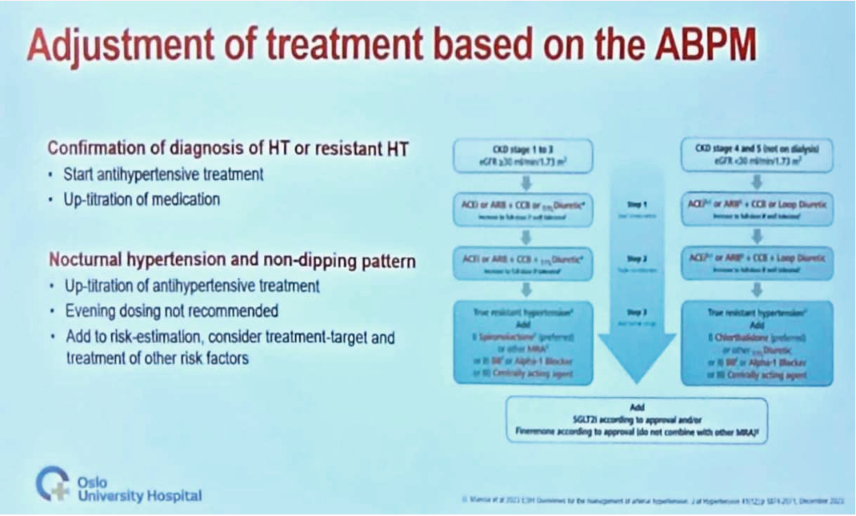
- Confirms resistant hypertension and guides antihypertensive up-titration.
- Informs therapy selection: ACEi/ARB across CKD stages 1–5; emerging therapies include SGLT2 inhibitors and finerenone.
- Evening dosing for nocturnal hypertension is currently not guideline-recommended.
24-hour ABPM should be considered in all CKD patients to detect masked and nocturnal hypertension, confirm resistant hypertension, assess CV risk, and guide individualized therapy. Optimizing ABPM use, validated devices, comprehensive parameter interpretation, and repeat measurements, is essential to improve BP control, slow CKD progression, and reduce cardiovascular morbidity and mortality in this high-risk population.