
by Prateek Chopra | June 7, 2026 | Cardiology Conferences | ESH 2026
Precision Cardiovascular Prevention:
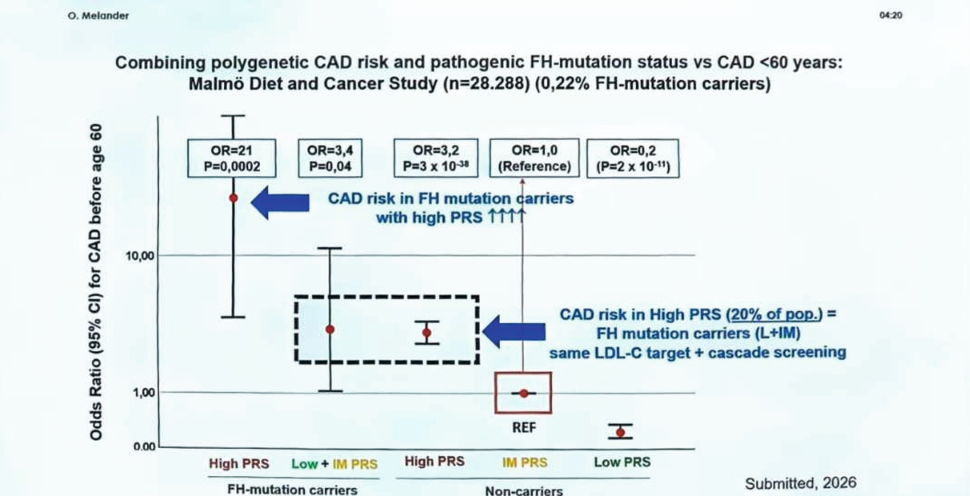
Integrated polygenic risk scores (PRS) enhance risk stratification beyond traditional risk factors. PRS predicts coronary artery disease (CAD) 2–4 times more strongly than conventional risk factors and identifies high-risk individuals not captured by family history or standard clinical assessments.
High-Risk Populations:
- Nature Medicine 2023: 20% of the population carries a high CAD-PRS comparable to type 2 diabetes, while 8% have a risk similar to peripheral artery disease.
- These “hidden high-risk” individuals may benefit from early preventive interventions.
Evidence from Clinical Trials:
- Statins & PCSK9 inhibitors: Greatest reductions in myocardial infarction and stroke occur in the highest genetic risk category; minimal benefit in lowest-risk individuals despite treatment exposure.
- ASPREE analysis: Aspirin reduced CAD risk by 47% in the top 20% PRS group without excess major bleeding; lower-risk groups had 30% higher significant bleeding risk with no CV benefit.
PRS and Lipid Management:
- Nature Medicine 2025 meta-prediction: Combining PRS with LDL-C targets identifies the 20% most likely to benefit from intensive lipid lowering.
- Lifestyle modifications substantially reduce CAD risk across all genetic-risk categories.
- Polygenic testing in 10,114 participants reduced verified CAD events by nearly 50% (HR 0.51, 95% CI 0.35–0.74; P<0.001).
Clinical Integration:
- Incorporation of CAD-PRS into pooled cohort equations improved quality-adjusted life-years, reduced healthcare costs, and prevented CAD and ischemic stroke events.
- The 2026 ACC/AHA Dyslipidemia Guidelines recognize high polygenic risk as a cardiovascular risk-enhancing factor, supporting clinical translation of PRS.
Limitations & Challenges:
- Implementation barriers, ancestry diversity, and standardization issues remain.
- Need for equitable integration into routine clinical practice.
PRS provides a powerful framework for precision cardiovascular prevention, enabling personalized allocation of pharmacological and lifestyle interventions to optimize outcomes and reduce residual risk in high-risk populations.