
by Prateek Chopra | June 5, 2026 | Cardiology Conferences | ESH 2026
Study Objective:
Evaluate early low-dose triple and quadruple antihypertensive therapy versus stepwise monotherapy across diverse ethnic populations, synthesizing evidence from six landmark RCTs: QUARTET (n=591), TRIUMPH (n=700), QUADRO (n=183), Trident Trial (~1,670), VERONICA (n=300), and CREOLE (n=728). Outcomes included BP reduction, hypertension control, tolerability, and fourth-agent selection in African populations.
Key Findings
Blood Pressure Control:
- QUARTET: 81% controlled at 12 months vs 62% usual care; 6.9 mmHg systolic reduction at 3 months.
- TRIUMPH: target BP achieved in 70% vs 55% standard care.
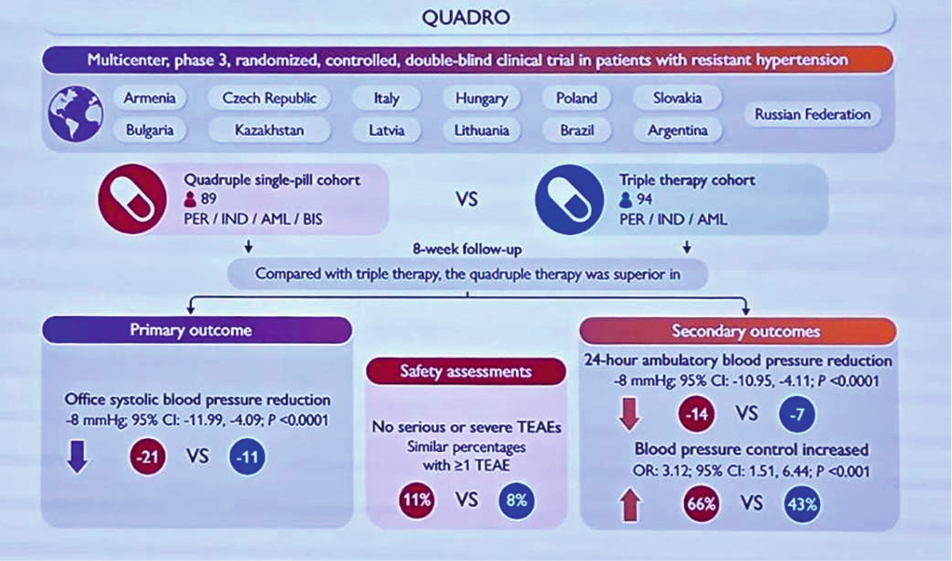
- QUADRO: 8 mmHg greater systolic reduction; 66% vs 43% BP control.
- Trident Trial: 39% reduction in cardiovascular events (HR 0.61).
Tolerability & Safety:
- Hypokalemia observed in 34% of Black African patients on diuretic-containing triple therapy vs 18% standard care.
- Risk mitigated by amiloride or potassium-enriched salt substitutes.
- Amiloride non-inferior to spironolactone as potassium-sparing fourth agent.
Population-Specific Considerations:
- Pharmacogenomic factors, including R563Q mutation in Black South Africans, can guide individualized fourth-agent selection.
Clinical Implications:
- Early low-dose triple/quadruple therapy offers superior BP control and reduces cardiovascular events compared with stepwise monotherapy.
- Hypokalemia management and population-specific adjustments are critical to optimize safety and efficacy.
Implementing early low-dose multi-drug antihypertensive strategies can significantly improve BP control, reduce cardiovascular risk, and address the global burden of uncontrolled hypertension when tailored to patient-specific and population-specific factors.