
by Prateek Chopra | July 1, 2026 | Diabetes Conferences | ADA 2026
Therapy Overview
- Orforglipron is an investigational once-daily oral, non-peptide GLP-1 receptor agonist.
- It is designed to improve glycemic control and support weight loss without the need for injections.
ACHIEVE Clinical Programme
- ACHIEVE-2: Compared orforglipron with dapagliflozin.
- ACHIEVE-3: Compared orforglipron with oral semaglutide.
- ACHIEVE-5: Evaluated orforglipron in patients receiving basal insulin therapy.
ACHIEVE-2 Findings (n=962)
- Orforglipron demonstrated superiority over dapagliflozin across glycemic and weight-loss outcomes.
- HbA1c reduction:
- Orforglipron: 1.3%–1.7%.
- Dapagliflozin: 0.8%.
- Weight reduction:
- Orforglipron: 6.3%–7.3%.
- Dapagliflozin: 3.0%.
- Up to 80% of participants achieved HbA1c <7%.
ACHIEVE-3 Findings (n=1,968)
- Orforglipron achieved greater glycemic and weight benefits than oral semaglutide.
- At Week 52:
- HbA1c reduction:
- Orforglipron 36 mg: 1.9%.
- Oral semaglutide 14 mg: 1.5%.
- Weight reduction:
- Orforglipron: 8.2%.
- Oral semaglutide: 5.3%.
- HbA1c reduction:
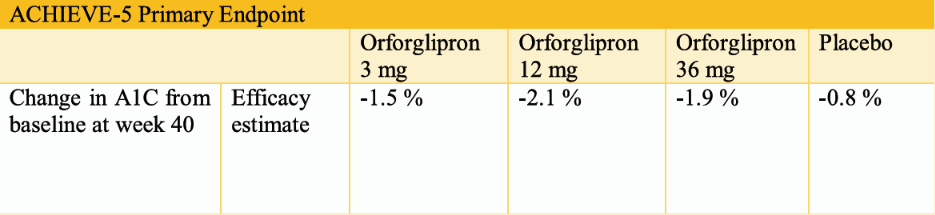
ACHIEVE-5 Findings (n=546)
- Conducted in participants inadequately controlled on insulin glargine.
- HbA1c reductions:
- 3 mg: 1.58%.
- 12 mg: 1.88%.
- 36 mg: 1.82%.
- Placebo: 0.79%.
- Approximately 70% achieved HbA1c <7% versus 25% with placebo.
- Nearly half of the participants achieved ≤5% weight loss at higher doses.
- No increased risk of hypoglycemia was observed.
Safety Profile
- Gastrointestinal adverse events were the most commonly reported side effects.
- A modest increase in heart rate was observed.
- No major new safety concerns were identified.
Clinical Implications
- Orforglipron consistently improved glycemic control and body weight across diverse T2D populations.
- As an oral GLP-1 receptor agonist, it may provide an attractive alternative for individuals unwilling or unable to use injectable therapy.
The ACHIEVE programme demonstrated that oral orforglipron delivers substantial HbA1c reductions, meaningful weight loss, and favorable cardiometabolic benefits. These findings support its potential as an effective oral alternative to injectable GLP-1 receptor agonists for the management of type 2 diabetes.