
by Prateek Chopra | June 13, 2026 | Diabetes Conferences | ADA 2026 | 0 comments
Cardiovascular Risk in Diabetes:
- Cardiovascular disease (CVD) prevalence increases with age and remains a leading cause of mortality in people with diabetes.
- Patients with diabetes experience significantly higher mortality following acute myocardial infarction (AMI), underscoring the need for early cardiovascular risk assessment and preventive strategies.
Impact of Cardiovascular Disease in Diabetes:
- Patients with diabetes have sustained reductions in survival after myocardial infarction, with a median loss of more than 3 years of life expectancy.
- Severe left main coronary artery calcification is associated with markedly increased risks of ASCVD, coronary heart disease (CHD), and all-cause mortality.
Role of Coronary Artery Calcification (CAC):
- CAC is highly prevalent among individuals with diabetes, with prevalence increasing progressively with age.
- Detection of CAC identifies patients at elevated atherosclerotic cardiovascular risk and supports intensification of preventive therapies.
Evidence from Clinical Studies:
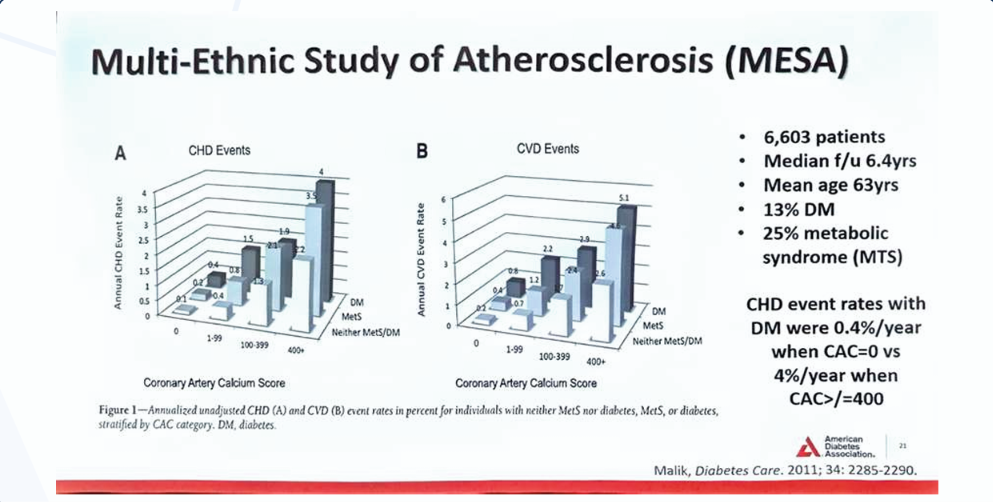
- In the MESA study, individuals with diabetes and a CAC score of 0 had a low annual CHD event rate of 0.4%.
- Those with a CAC score ≥400 experienced a tenfold higher annual CHD event rate of 4.0%.
- Cardiovascular event rates increased progressively with rising CAC scores regardless of diabetes or metabolic syndrome status.
- Patients with diabetes and CAC >400 experienced the highest rates of CHD death, CVD death, and all-cause mortality.
Guideline Recommendations:
- The 2026 ACC/AHA Dyslipidemia Guidelines recommend CAC scoring to refine ASCVD risk assessment in adults without established ASCVD, particularly those with borderline (3–5%) or intermediate (5–10%) 10-year cardiovascular risk.
- Patients with CAC should receive intensive lipid-lowering therapy targeting LDL-C <70 mg/dL and at least a 50% reduction from baseline.
- An LDL-C target <55 mg/dL may be considered in those at very high cardiovascular risk.
Additional Risk Stratification Considerations:
- Women were more likely than men to have no detectable CAC (38% vs 19%), although mortality increased substantially with higher CAC scores in both sexes.
- Patients with clinical ASCVD and diabetes-associated risk enhancers should be considered at very high cardiovascular risk.
- One-time lipoprotein(a) testing may provide additional cardiovascular risk information.
Clinical Implications:
- Routine assessment of vascular calcification on imaging studies can improve cardiovascular risk identification.
- CAC scoring can help guide preventive interventions and personalize risk management strategies in people with diabetes.
Imaging findings, particularly coronary artery calcification, provide valuable information for cardiovascular risk stratification in people with diabetes. Incorporating CAC assessment and lipoprotein(a) testing into routine practice may facilitate earlier identification of high risk individuals and support more effective preventive cardiovascular care.